Tuesday, 7 November 2023

Slope deflection method for beams

This blog post illustrates the use of the slope-deflection method to analyse indeterminate beams

 The following steps are followed in the slope-deflection method 

  1.  Identifying the unknown joint displacements /kinematic indeterminacy/Degree of Freedom (DOFs)
  2.  Write slope deflection equations (SDEs) for each member. This includes substituting the fixed end moments (due to span loading) in SDEs, substituting known joint displacements in each SDE
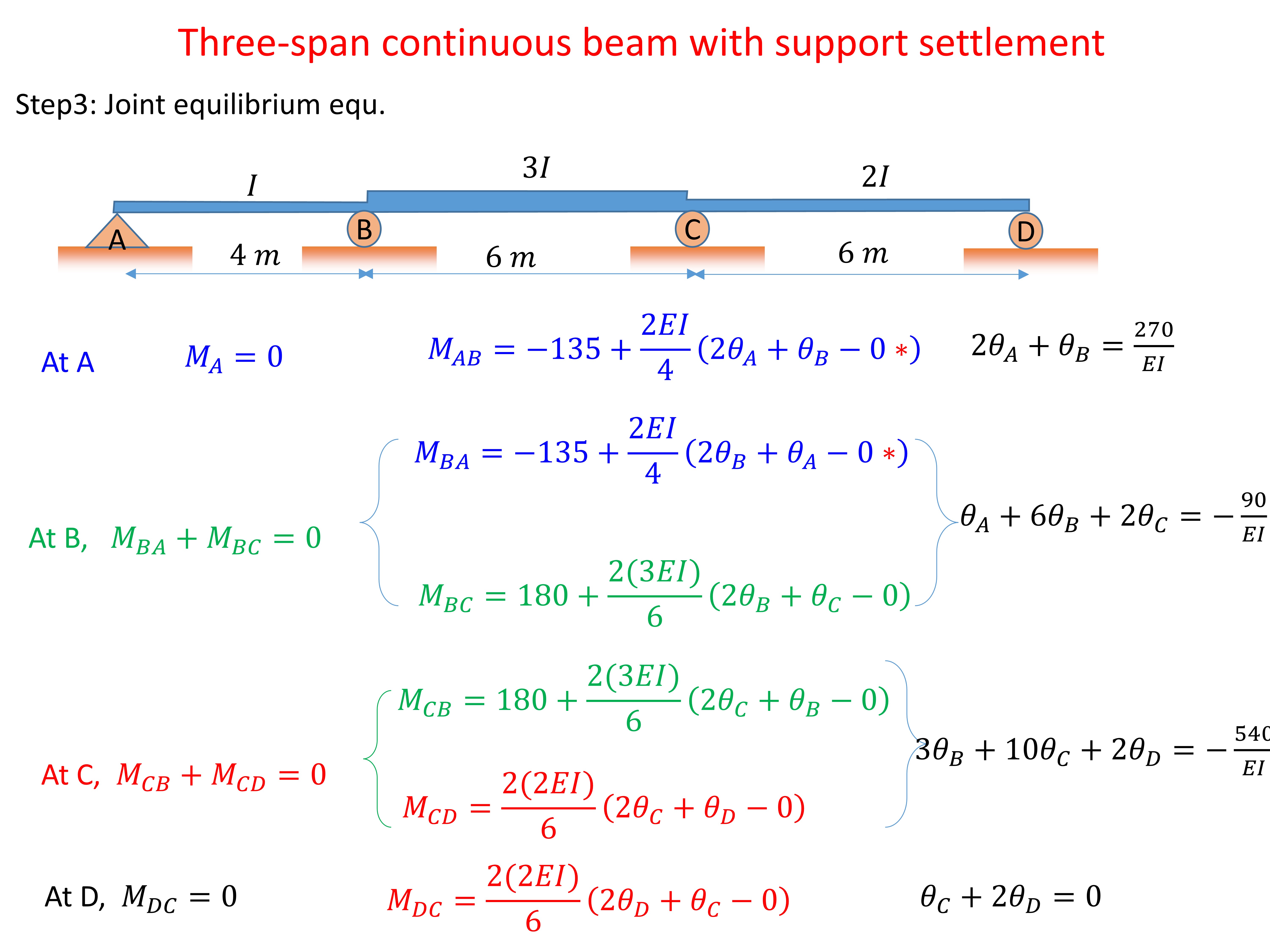
  3. Write the joint equilibrium equations for each joint having a DOF. Substituting SDEs in joint equilibrium equations
  4. Solve the joint equilibrium equations simultaneously for unknown joint displacements
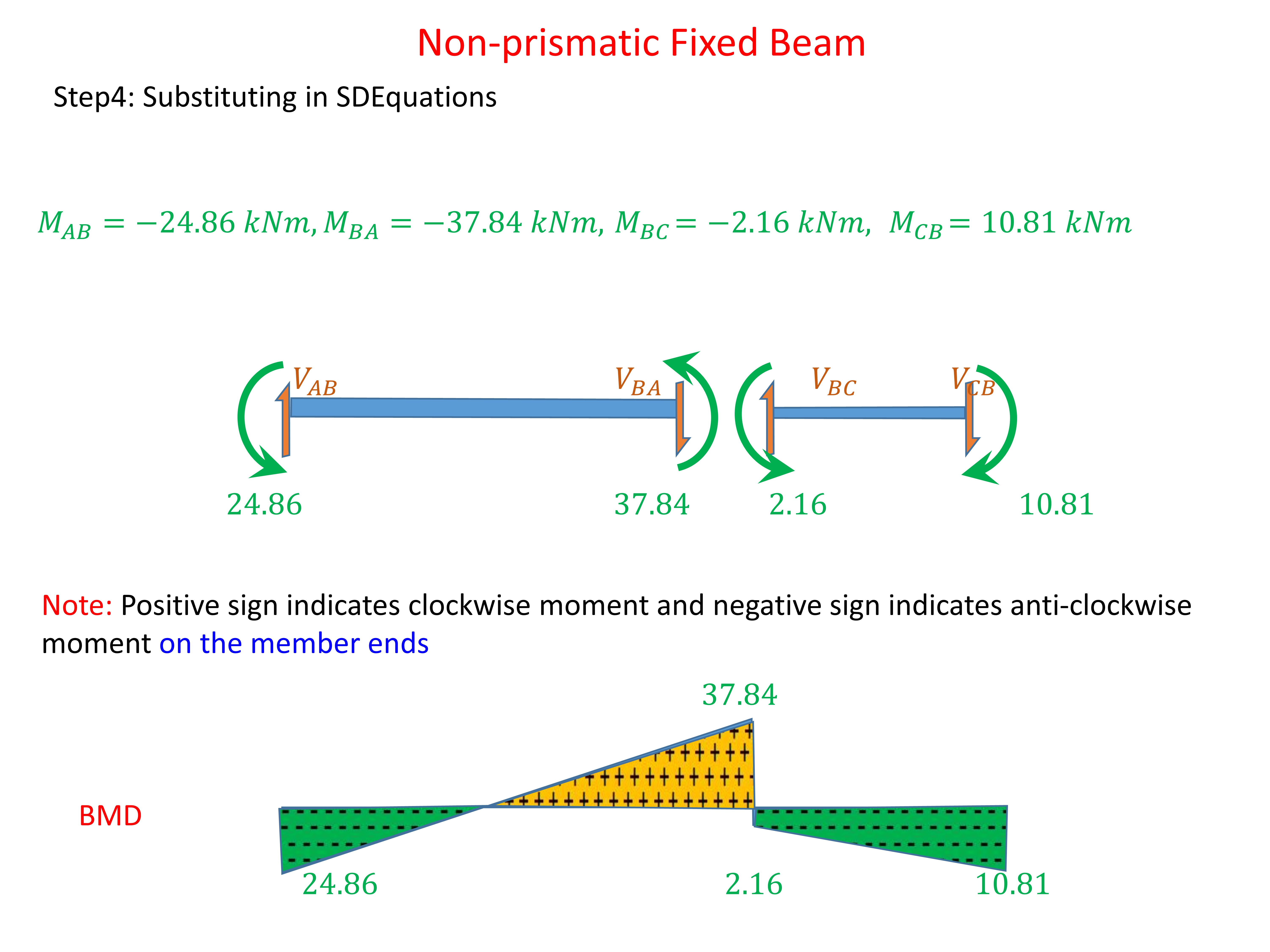
  5. Substituting the joint displacements in SDEs to evaluate the member end moments
  6. Drawing the deflected shape and BMD for the frame

                 Illustrative Example-1                             
In the two-span continuous beam given below, there is only one kinematic indeterminacy (or unknow joint displacement). That is, the rotation at B (or slope at B)


                             Illustrative Example-2                                          
In this example, there are two unknown joint displacements (Kinematic indeterminacy=2). These are the rotations at joints B and C


            Illustrative Example-3                                


Tuesday, 27 June 2023

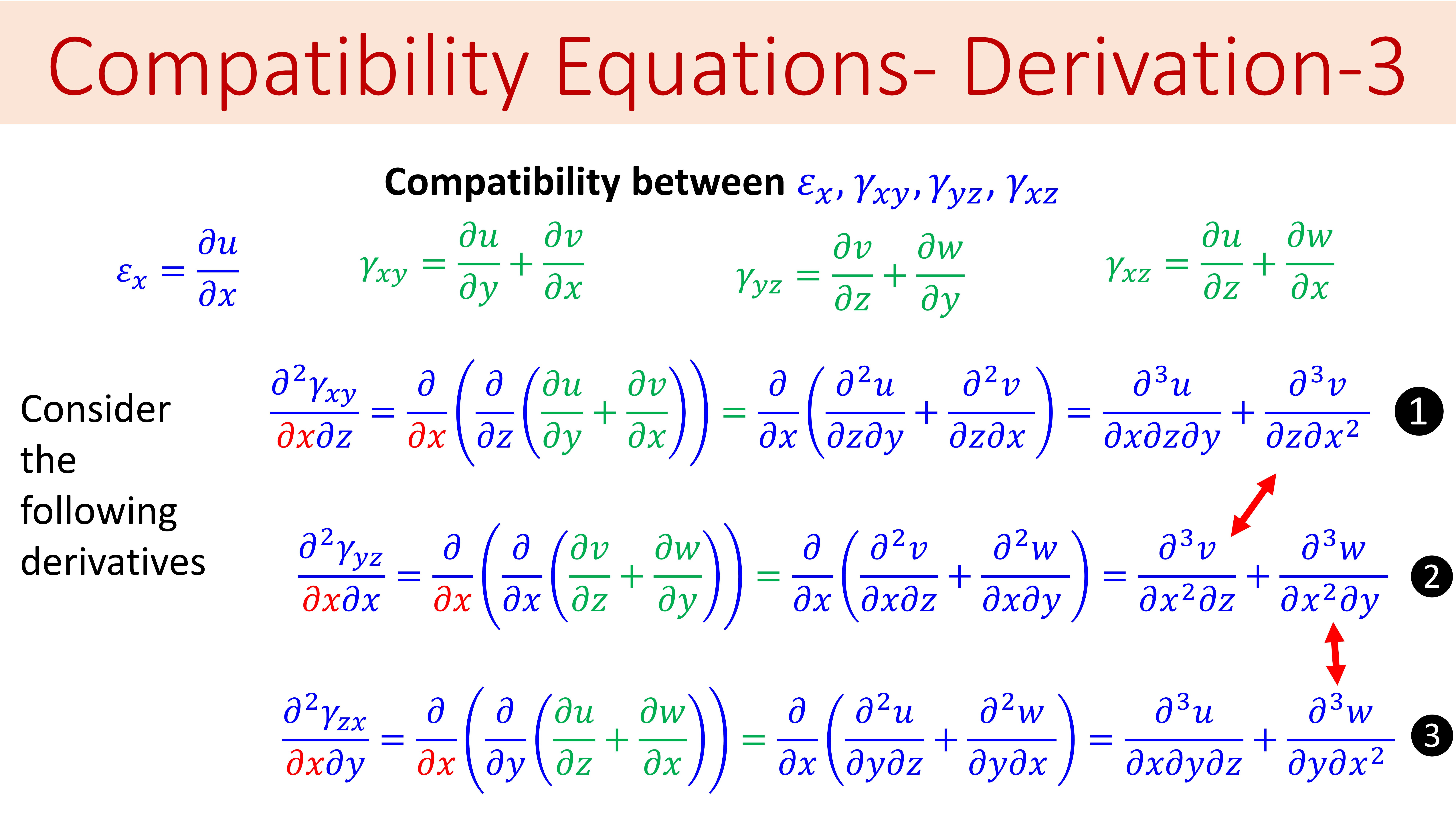
Compatibility Equations

 For the deformed body to have a compatible deformation (deformation without discontinuities), the displacement field formed by the strain components should be continuous. For this to be satisfied, the strains should satisfy the compatibility conditions described as below


Wednesday, 10 May 2023

Stress Invariants and Principal stresses


To determine the roots of a cubic equation using calculator, follow the steps in the video below


Equilibrium equations - Relationship between stress components

 Equilibrium equations - Relationship between stress components

When a body is subjected to loads, stresses are developed in all portions of the body. But, the stresses should develop in such a way that the sum of all forces should be zero, i.e the force balance should be satisfied in all directions, including along x-, y- and z- directions. In the following paragraphs, the relationship between various stress components of a DIFFERENTIAL ELEMENT is derived based on the equilibrium conditions. The resultant relationships are thus referred to as equilibrium equations in 3D.


In addition to the stresses on all the six faces, there can be body forces, which are developed within the volume. For example, the gravity force is developed in proportion to the volume of the differential element considered. Such volume-proportional forces are referred to as body forces. Their contribution is to be considered in the EQUILIBRIUM equations.